
 © Kenny Schaaf, NMLS #1413092
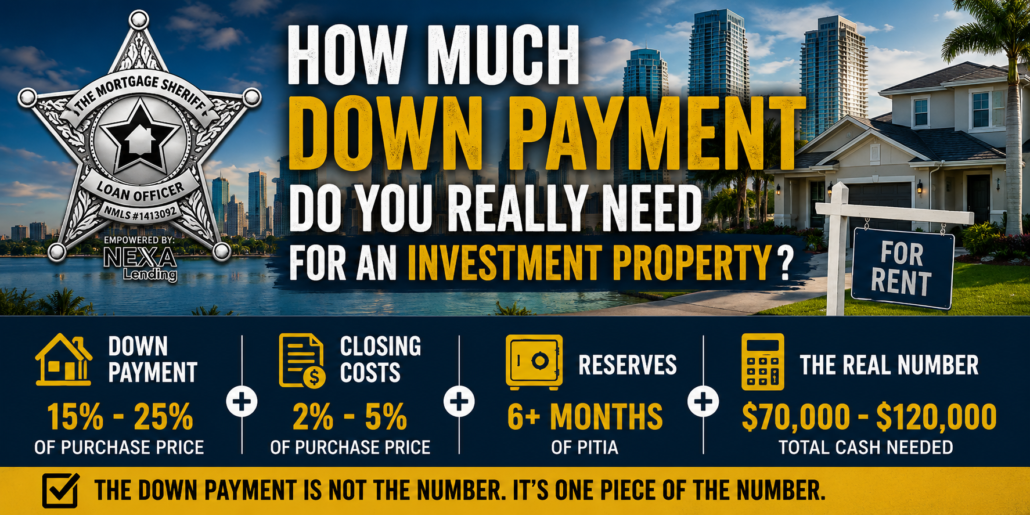
Every first-time investor asks some version of this question eventually: “How much money do I actually need to make this happen?” And almost every answer they find online is incomplete, because most articles only talk about the down payment. The down payment is not the number. It’s one piece of the number.
Here’s the full breakdown, the way I’d walk through it with you in person.
The Down Payment: Bigger Than You Think
Investment properties don’t get the same low down payment options as a primary residence. There’s no 3% or 3.5% down here. Expect somewhere in the 15-25% range depending on the loan program, property type, and your credit profile.
Conventional investment loans typically start around 15% down for a single-family rental, though multi-unit properties often require 25%. DSCR loans, which qualify based on the property’s rental income rather than your personal income, usually run a bit higher, often in the 20-25% range, since the lender is taking on more risk by skipping personal income verification. I broke down exactly how that qualification works in what a DSCR loan actually looks at, if you want the full picture on that program.
On a $350,000 property, that’s the difference between roughly $52,500 down at 15%, and $87,500 down at 25%. That range is exactly why “how much do I need” doesn’t have a one-size answer. It depends on the loan structure, and the loan structure depends on you.
Closing Costs: The Number Everyone Forgets
Down payment gets all the attention. Closing costs quietly add another 2-5% of the purchase price on top of it. On that same $350,000 property, that’s another $7,000 to $17,500.
Closing costs on an investment purchase include the usual suspects, lender fees, title insurance, appraisal, recording fees, but often run a bit higher than an owner-occupied purchase because appraisals for investment properties sometimes require a rent schedule, and title work can carry slightly higher costs depending on how you’re taking title (personal name vs. an LLC).
Reserves: What Lenders Actually Require You to Have Left Over
This is the piece that surprises the most first-time investors. It’s not enough to have the down payment and closing costs covered. Most investment property loans require reserves, meaning cash left in the bank after closing, equal to several months of the full mortgage payment.
Requirements vary, but 6 months of PITIA (principal, interest, taxes, insurance, and association dues if applicable) is a common baseline, and some programs want more depending on how many financed properties you already own. On a $2,000 monthly payment, that’s $12,000 sitting untouched in reserve, not spent on the purchase, just proven to exist.
This isn’t a lender being difficult. It’s protection, for the lender and for you, against the exact scenario every first-time investor fears: a vacancy or repair that turns into a cash crunch three months after closing.
Putting the Real Number Together
Here’s what actually buying a $350,000 investment property tends to require, all in:
- Down payment (conventional, 15-25%): $52,500 to $87,500
- Closing costs (2-5%): $7,000 to $17,500
- Reserves (6+ months PITIA): roughly $10,000 to $15,000 depending on the payment
That’s a real range of $70,000 to $120,000 in total cash needed, not $52,500. This is the gap between what most people assume and what the deal actually requires, and it’s the single biggest reason first-time investors get caught off guard mid-process.
If you want to see where your own numbers land, run a few scenarios through the mortgage calculator on my site using a realistic purchase price and down payment. It won’t show reserves or closing costs, but it’ll get you the core payment number fast, and that payment number is what your reserve requirement gets built from.
Where That Cash Can Actually Come From
Most first-time investors aren’t sitting on six figures in a checking account, and they don’t need to be. The money for a deal like this typically comes from a combination of sources:
Equity in your primary residence. If you’ve owned your home a few years, especially in this market, you may have more usable equity than you realize. This is often the single biggest unlock for someone moving from homeowner to investor.
Savings and liquid investments. Straightforward, but worth confirming early, since lenders will want to see seasoned funds (typically sitting in the account for 60+ days) rather than a lump sum that just appeared.
Gift funds, in some cases, though rules here vary by loan program and are more restrictive on investment properties than on primary residences.
The point isn’t to guess which of these applies to you. It’s to have that conversation before you’re three offers deep into a property search and scrambling to figure out if you actually have access to the cash a deal requires.
The Mistake This Prevents
I wrote recently about the most common mistakes first-time investors make, and underestimating the real cash required didn’t make the list by accident, it’s one of the most common ways a deal falls apart late, after an offer’s already been accepted. Knowing the full number now, down payment, closing costs, and reserves combined, is what keeps that from happening to you.
Get Your Real Number, Not a Guess
The percentages above are ranges because your situation isn’t generic. Your credit profile, the loan program that fits you, the property type, and how much equity you’ve already built all move these numbers up or down.
Send me the purchase price you’re considering, and I’ll give you the real number, down payment, closing costs, and reserves, specific to your situation. If a DSCR loan or conventional loan changes that number meaningfully in your favor, I’ll tell you which one and why. If the cash you have on hand doesn’t quite get you there yet, I’ll tell you that too, along with what would close the gap.
Not working with the Sheriff otta be a crime.
Kenny Schaaf | The Mortgage Sheriff | NMLS #1413092 | NEXA Mortgage, LLC NMLS #1660690 (813) 394-0764 | kschaaf@nexalending.com
Disclosure: This is not an offer to enter into an agreement. Not all customers will qualify. Information, rates, and programs are subject to change without notice. All loans are subject to credit and property approval. Other restrictions and limitations may apply.