Credit Score for a Mortgage in Tampa: What First Responders Should Know
If you work for Tampa Fire Rescue, Hillsborough County Fire Rescue, Tampa PD, HCSO, Plant City PD or Fire, or you’re running calls anywhere from Brandon to Wesley Chapel, there’s a good chance credit is the thing keeping you up at night about buying a home. Not the down payment. Not the interest rate. The number.
I get it. Nobody explained how credit actually works when it came to qualifying for a mortgage — they just told you it “matters” and left it at that. So let’s fix that. Here’s what your credit score for a mortgage actually needs to look like in this market, and how to prepare it the right way before you apply.
Why Tampa Area First Responders Worry About Credit More Than They Should
Shift work messes with your finances in ways a 9-to-5 desk job never will. Overtime that hits one month and disappears the next. Bills that get paid late because you were working a 24-hour shift out of a station in Riverview or Seminole Heights and missed the due date by a day. A credit card balance that crept up during a slow stretch between departments.
Stack that on top of a Tampa Bay housing market that’s only gotten more competitive over the last several years — Hillsborough, Pinellas, and Pasco counties have all seen home prices climb — and it’s easy to convince yourself your credit isn’t good enough to compete. None of that makes you a credit risk. It makes you human, working a job most people couldn’t survive a week of. But because nobody’s explained the actual mechanics of mortgage credit to you, the fear fills in the gaps — and that fear is usually bigger than the reality.
The Most Common Credit Fears I Hear From First Responders
Three come up constantly:
- “My score isn’t good enough.” Most people have no idea what score they actually need — so they assume the worst and put off buying for years over a number they’ve never even checked with a lender.
- “I have old collections or a late payment from years ago.” One bad stretch does not define your file. Age matters, pattern matters, and there are ways to address old marks that most people never hear about.
- “Checking my credit will hurt it.” This one costs first responders real opportunities. A soft pull from a loan officer reviewing your options costs you nothing. Waiting because you’re scared to look costs you time and, often, money — and in a market like Tampa Bay, where homes in areas like Brandon, Riverview, and Wesley Chapel don’t sit long, time matters.
What Actually Matters on Your Credit Report for Mortgage Qualifying
A lender isn’t looking for a perfect file. We’re looking for a pattern. Four things carry the most weight:
- Payment history — Are your accounts being paid on time now, consistently? Recent behavior outweighs old mistakes.
- Credit utilization — How much of your available credit you’re using. Under 30% is solid. Under 10% is stronger.
- Length of credit history — Older accounts help you. Closing them doesn’t help your score — it can hurt it.
- Recent inquiries and new accounts — Opening new credit right before applying for a mortgage raises flags. Timing matters here.
None of this requires a perfect score. It requires a clear pattern a lender can document and defend to underwriting.
How to Prepare Your Credit Before You Apply
If you’re planning to buy in the next 3-12 months, here’s the order of operations:
- Pull your actual credit report — not just an app score. Know exactly what’s on there before a lender does.
- Pay down revolving balances first — credit card utilization moves your score faster than almost anything else.
- Don’t close old accounts — even ones you don’t use. Length of history counts in your favor.
- Address errors directly — misreported accounts, wrong balances, or accounts that aren’t yours get disputed, not ignored.
- Talk to a loan officer before you need one — not after you’ve found a house. A pre-purchase credit review gives you time to fix what’s fixable and stop worrying about what isn’t.
If you already bank with a local credit union — Suncoast, GTE Financial, MIDFLORIDA, or similar — that’s a fine place to start, but make sure whoever reviews your file actually understands first responder pay structures. A lot of first responders in the Tampa area get steered into a generic pre-approval that doesn’t reflect what they really qualify for.
What NOT to Do While Preparing to Buy
- Don’t open a new credit card for “rewards” in the months before applying.
- Don’t finance a new vehicle right before you’re ready to buy a house.
- Don’t pay off and close old accounts thinking it “cleans up” your file — it can do the opposite.
- Don’t guess. Get your actual numbers reviewed instead of assuming the worst.
Bottom Line
Your credit doesn’t need to be perfect. It needs to be understood — by you and by whoever’s reviewing your file. First responders across Hillsborough, Pinellas, and Pasco counties get denied or talked out of buying more often over fear than over facts. That’s not protection. That’s the opposite of it.
I spent 30 years in law enforcement, dispatch, and fire/EMS right here in the Tampa Bay area before I ever closed a mortgage. I know shift work messes with finances in ways most loan officers never bother to understand, and I know this local market — from Plant City to South Tampa to the beaches. My job is to look at your actual file, tell you the truth about where you stand, and give you a plan — not a guess.
If you’re not sure where your credit stands for a mortgage, let’s find out together. No pressure, no pitch — just a real answer.
FAQ: Credit and Mortgage Qualifying for First Responders
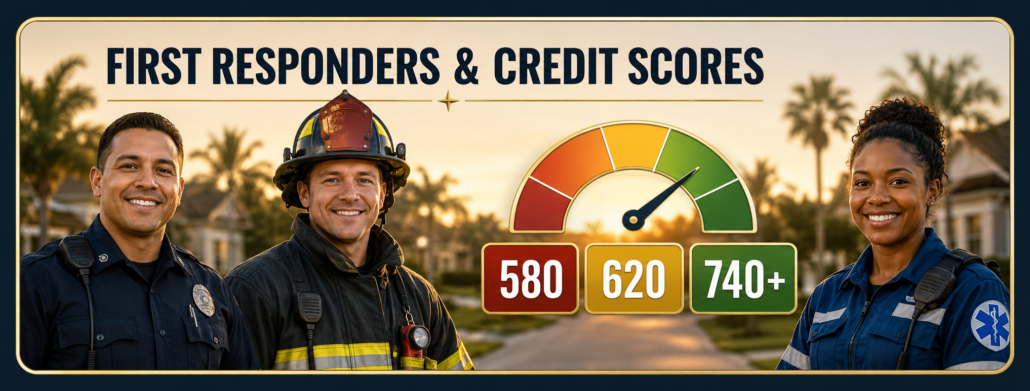
What credit score do I need to buy a house as a first responder? Conventional loans typically start around 620, and FHA loans can go as low as 580 with 3.5% down — some programs allow even lower with compensating factors. The score needed depends on the loan program, not a fixed universal number.
Will checking my credit hurt my score before I apply for a mortgage? No. A soft credit pull used to review your options doesn’t affect your score. Only a hard inquiry, which happens when you formally apply, has any impact — and that impact is minor and temporary.
Do old collections disqualify me from getting a mortgage? Not automatically. Lenders look at the age, amount, and pattern surrounding old collections. Many first responders qualify despite past marks once the full picture and recent payment history are documented correctly.
How long before buying a home should I start preparing my credit? Ideally 3-6 months before you plan to apply, though even a same-week credit review can catch fixable issues. Earlier is always better — it gives time to correct errors and pay down balances before they’re evaluated.
Should I pay off all my debt before applying for a mortgage? Not necessarily, and sometimes it can work against you. Utilization and payment history matter more than a zero balance. A lender should tell you specifically what to pay down and what to leave alone.


 © Kenny Schaaf, NMLS #1413092